Free holiday intensive · Week 3

Graphs and applications

Move between equations, graphs, tables and contexts. These 12 original questions carry 54 marks; allow about 80 minutes plus review.

Before you practise

Method 1

Translate the representation

On a speed–time graph, area gives distance. On a distance–time graph, gradient gives speed. A horizontal segment has different meanings on those two graphs.

Worked example: a vehicle moves at 8 ms for 10 s. The rectangle under its speed–time graph has area 8 × 10 = 80 m, so it travels 80 m.

Common mistake: Calling a horizontal speed–time segment a stop; it means constant speed when it is above zero.

Method 2

Use coordinates and graph features together

A gradient describes a line's direction. Intersections satisfy both equations. For a quadratic, factorisation gives x-intercepts and completing the square gives the turning point.

Worked example: y = x²−2x−8 = (x−4)(x+2) crosses the x-axis at −2 and 4. Writing y = (x−1)²−9 shows its minimum at (1,−9).

Common mistake: Treating the y-intercept as a root or reading a minimum from an unscaled sketch.

Method 3

Check the base and the units

A percentage change acts on the current amount. A grouped-data mean uses class midpoints and is an estimate. State what quantity each number represents before interpreting it.

Worked example: after a 20% discount, a book costs $64. The original price P satisfies 0.80P = 64, so P = $80. Work backward by dividing by the multiplier.

Common mistake: Adding 20% to $64 instead of reversing the discount from the original base.

Practice

Warm-ups

Question 1

4 marks

A line passes through (−2,3) and (4,−1). Find its gradient, equation and x-intercept.

See the worked solution
  1. Gradient m = (−1−3)/(4−(−2)) = −46 = −23.
  2. Using y = mx + c and (−2,3): 3 = 43 + c, so c = 53. The line is y = −(23)x + 53.
  3. Set y = 0: 0 = −2x + 5 after multiplying by 3, giving x = 52. The x-intercept is (52,0).

Check your reasoning: Subtract x-coordinates in the same point order as y-coordinates.
Question 2

3 marks

A price rises by 10% and then falls by 10%. Find the final price if it began at $200, and explain why it does not return to $200.

See the worked solution
  1. After the rise: $200 × 1.10 = $220.
  2. After the fall: $220 × 0.90 = $198, a $2 or 1% decrease from the original.
  3. The second 10% is taken from $220, not $200.

Check your reasoning: The two percentage changes have different bases.

Practice

Core applications

Question 3

5 marks

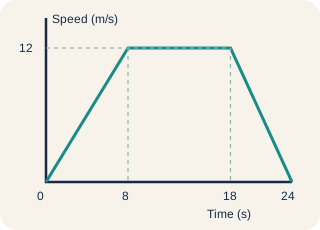
A speed–time graph joins (0 s,0 ms), (8 s,12 ms), (18 s,12 ms) and (24 s,0 ms) with straight segments. Find the total distance and average speed over 24 s.

Speed–time graph through 0,0; 8 seconds,12 metres per second; 18 seconds,12; and 24 seconds,0.
See the worked solution
  1. Area from 0–8 s is a triangle: (12)(8)(12) = 48 m.
  2. Area from 8–18 s is a rectangle: (10)(12) = 120 m. Area from 18–24 s is a triangle: (12)(6)(12) = 36 m.
  3. Total distance = 48 + 120 + 36 = 204 m. Average speed = 20424 = 8.5 ms.

Check your reasoning: Average speed is total distance divided by total time; it is not the mean of the plotted speeds.

Question 4

4 marks

A jacket's price is reduced by 20%, then a 10% surcharge is applied to the reduced price. The final price is $88. Find the original price and check it forward.

See the worked solution
  1. Let the original price be P dollars. The final price is 0.80 × 1.10 × P = 0.88P.
  2. So 0.88P = 88 and P = $100.
  3. Check: $100 → $80 after the reduction → $88 after the surcharge.

Check your reasoning: The surcharge is applied to $80, not to the original $100.

Question 5

4 marks

In a grouped table, masses 0–<10 g, 10–<20 g and 20–<30 g have frequencies 4, 6 and 10. Estimate the mean mass and identify the modal class. Explain why the mean is an estimate.

See the worked solution
  1. Use class midpoints 5, 15 and 25 g. The estimated total is 4(5)+6(15)+10(25)=360 g for 20 items.
  2. Estimated mean = 36020 = 18 g. The modal class is 20–<30 g because it has the greatest frequency, 10.
  3. Individual masses are not given; replacing each value by its class midpoint makes the mean an estimate.

Check your reasoning: Do not divide by the number of classes or treat each midpoint as occurring once.

Question 6

4 marks

Two mobile plans have monthly costs A(t) = 8 + 0.20t dollars and B(t) = 20 dollars for t minutes of calls, with t ≥ 0. Find when their costs are equal and when B is cheaper. Interpret the boundary.

See the worked solution
  1. Set 8 + 0.20t = 20. Then 0.20t = 12 and t = 60 minutes.
  2. B is cheaper when 20 < 8 + 0.20t, or t > 60.
  3. At exactly 60 minutes the costs are equal; at fewer than 60 minutes A costs less.

Check your reasoning: The inequality direction should match the plan whose cost is being compared.

Practice

Challenging reasoning

Question 7

5 marks

A(0,0), B(6,0) and C(2,5) are vertices of a triangle. Find its area, the midpoint M of BC and the equation of AM.

See the worked solution
  1. AB is horizontal with length 6; C is 5 units above it. Area = (12)(6)(5) = 15 square units.
  2. M = ((6+2)2,(0+5)2) = (4,52).
  3. Gradient of AM is (5/2)4 = 58. Since A is the origin, AM has equation y = (58)x.

Check your reasoning: The midpoint's y-coordinate is 52, not 5; use both endpoint coordinates.

Question 8

5 marks

A cyclist travels 60 km outward at 30 kmh, rests for 1 hour, then returns 60 km at 60 kmh. Find the total elapsed time, average speed for the whole trip and average speed while moving.

See the worked solution
  1. Outward time = 6030 = 2 h. Return time = 6060 = 1 h. Including the rest, elapsed time = 2+1+1 = 4 h.
  2. Total distance = 120 km, so whole-trip average speed = 1204 = 30 kmh.
  3. Moving time is 3 h, so moving-only average speed = 1203 = 40 kmh.

Check your reasoning: Do not take the arithmetic mean of 30 and 60; the two legs take different times, and the rest counts in whole-trip time.

Question 9

6 marks

For y = x² − 4x − 5, find the x-intercepts and turning point. Find where the curve meets the line y = −5. State which features can be read exactly from algebra without a scale drawing.

See the worked solution
  1. Factor y = (x−5)(x+1), so the x-intercepts are (5,0) and (−1,0).
  2. Complete the square: y = (x−2)²−9, so the minimum turning point is (2,−9).
  3. Set x²−4x−5 = −5. Then x(x−4)=0, giving intersections (0,−5) and (4,−5).
  4. All these coordinates follow exactly from the equations; a sketch alone is not required for exact values.

Check your reasoning: Setting y = −5 is different from setting y = 0 to find the x-intercepts.

Practice

Misconception analysis

Question 10

4 marks

Two classes have five-number summaries (minimum, Q1, median, Q3, maximum). Class A: 30, 42, 50, 58, 70. Class B: 25, 48, 52, 56, 80. Compare their medians and the spread of the middle half. Can you conclude which class has the greater mean?

See the worked solution
  1. Class B's median 52 is 2 higher than Class A's median 50.
  2. IQR(A) = 58−42 = 16; IQR(B) = 56−48 = 8. The middle half of B is less spread out by this measure.
  3. Five-number summaries do not determine the mean, so the greater mean cannot be concluded from this information alone.

Check your reasoning: A higher median does not prove a higher mean; the data within quartile ranges are unknown.

Question 11

4 marks

On a speed–time graph, a horizontal segment at 12 ms lasts from t = 8 s to t = 18 s. A student says the object was stopped for 10 s because the graph was horizontal. Explain the error, find the distance during the segment and state what a horizontal distance–time segment would mean.

See the worked solution
  1. A horizontal speed–time segment above zero means constant speed, here 12 ms, not a stop.
  2. Distance during the 10 s interval is the rectangle area 12 × (18−8) = 120 m.
  3. A horizontal distance–time segment has zero gradient, so distance does not change and the object is stopped.

Check your reasoning: Name the vertical axis before interpreting the shape of a graph.

Practice

Stretch

Question 12

6 marks

On one straight route, cyclist A starts at kilometre 0 and travels at 12 kmh. Cyclist B starts 6 km ahead, travels at 8 kmh for 1 hour, stops for 30 minutes, then resumes at 8 kmh. They start at the same time. Find when and where A first catches B, and who is ahead after 2 hours.

See the worked solution
  1. After 1 hour, A is at 12 km and B is at 6+8=14 km, so A has not yet caught B.
  2. During B’s 30-minute stop, B stays at 14 km. A needs 2 km more at 12 kmh: time 212 h = 16 h = 10 minutes.
  3. They first meet 1 hour 10 minutes after starting, at kilometre 14. This occurs during B’s stop.
  4. After 2 hours, A is at 24 km. B travelled for 1 hour, stopped 0.5 hour, then travelled another 0.5 hour: 6+8(1.5)=18 km. A is 6 km ahead.

Check your reasoning: A single straight-line equation for B does not apply during the stop; use the correct stage before solving.

Prefer paper?

The same 12 questions and worked solutions are available as optional PDFs (54 marks).