Free holiday intensive · Week 4

Exam mode

Try the mixed checks first, then the longer exam-mode tasks. Show your reasoning before opening a solution and review the first wrong decision. These 15 original questions carry 85 marks; allow about 150 minutes across two sittings plus review.

Before you practise

Method 1

Spend time where reasoning earns marks

Read the givens, name the method and write the first justified equation. If a route stalls, leave visible working and move on; return after the easier marks are secured.

Worked example: plans A(t) = 5 + 0.25t and B(t) = 15 cost the same when 5 + 0.25t = 15, giving t = 40 minutes. Translate the comparison before calculating.

Common mistake: Trying several formulas before translating the context into a clear equation.

Method 2

Check validity, not just arithmetic

A solution can satisfy a simplified expression but make the original one undefined. A length or probability must also make sense in context. Carry restrictions and units through the calculation.

Worked example: (x²−9)(x−3) simplifies to x+3 only for x≠3. Substituting x=3 into the simplified result cannot make the original fraction defined.

Common mistake: Accepting a cancelled denominator value as a root.

Method 3

Review the first incorrect choice

After a timed attempt, compare each solution step with your own. Classify an error as method choice, algebra, restriction, interpretation or unit. Then retry a related question without looking.

Worked example: if you averaged two journey speeds, recompute total distance divided by total elapsed time. The two stages may last different lengths of time.

Common mistake: Reading a final answer without finding where the reasoning first diverged.

Method 4

Scale the right measurement

For similar solids, a length ratio is not an area or volume ratio. Use the square of the ratio for areas and its cube for volumes. For a cut solid, subtract the removed part before calculating what remains.

Worked example: if corresponding lengths are in the ratio 2:3, corresponding areas are 4:9 and volumes are 8:27.

Common mistake: Multiplying a volume by a height ratio only once.

Method 5

Know what grouped data cannot tell you

Use class midpoints for an estimated mean and cumulative frequencies to locate a median class. The exact measurements inside a class are unknown.

Worked example: three journeys in 0–<10 minutes and five in 10–<20 minutes have estimated mean [3(5)+5(15)]8=11.25 minutes; the exact median cannot be found from the grouped table.

Common mistake: Treating an estimated mean or a median class as an exact measurement.
Practice

Timed checks

Question 1

4 marks

Solve the compound inequality 3x − 5 < 2x + 4 ≤ 4x + 10. Write the answer as one interval and test one boundary.

See the worked solution
  1. From 3x−5 < 2x+4, subtract 2x and add 5 to get x < 9.
  2. From 2x+4 ≤ 4x+10, subtract 2x and 10 to get −6 ≤ 2x, so x ≥ −3.
  3. Together, −3 ≤ x < 9. At x = −3, both original comparisons are true; x = 9 fails the strict first comparison.

Check your reasoning: Solve each comparison and take their intersection, not their union.

Question 2

4 marks

Solve 4x+1 = 82x−1. Give an exact answer and show a common-base check.

See the worked solution
  1. Rewrite 4 as 2² and 8 as 2³: 22x+2 = 26x−3.
  2. Equal positive-base powers have equal exponents, so 2x+2 = 6x−3 and 4x = 5.
  3. Thus x = 54. The exponents are both 92 at this value, so the powers agree.

Check your reasoning: The outside exponents multiply the original exponents 2 and 3; do not add them.

Practice

Mixed applications

Question 3

5 marks

A tank starts empty. Water enters at 6 litres per minute for 8 minutes, then at 4 litres per minute for 12 minutes. The tank holds 120 litres. How much more water is needed, and how long will that take at 3 litres per minute?

See the worked solution
  1. The first stage adds 6×8 = 48 litres. The second adds 4×12 = 48 litres.
  2. The tank contains 96 litres, so it needs 120−96 = 24 litres more.
  3. At 3 litres per minute, the remaining time is 243 = 8 minutes. Check that 48+48+24=120 litres.

Check your reasoning: A flow rate multiplies time to give volume; do not add rates from stages that occur one after another.

Question 4

4 marks

A bag has 3 red and 2 blue counters. Two are drawn without replacement. Find the probability of exactly one blue counter, showing the different possible orders.

See the worked solution
  1. Red then blue has probability (35)(24) = 310.
  2. Blue then red has probability (25)(34) = 310.
  3. The orders are disjoint, so add: 310+310 = 35.

Check your reasoning: Multiply within one order; add the probabilities of the two valid orders.

Question 5

6 marks

A(−1,2) and B(3,10) are endpoints of a segment. Find its midpoint, the equation of its perpendicular bisector and where that bisector meets the x-axis.

See the worked solution
  1. Midpoint M = ((−1+3)2,(2+10)2) = (1,6).
  2. Gradient AB = (10−2)/(3−(−1)) = 2, so a perpendicular line has gradient −12.
  3. Through M: y−6 = −(12)(x−1), or y = −x2+132.
  4. On the x-axis y=0, so x=13. The intersection is (13,0).

Check your reasoning: The bisector passes through the midpoint, not necessarily through either endpoint.

Question 6

4 marks

A map has scale 1:25 000. A path measures 7.2 cm on the map. A square park has side 2 cm on the same map. Find the path length in kilometres and the actual park area in hectares. (1 hectare = 10 000 m².)

See the worked solution
  1. Actual path length = 7.2×25 000 cm = 180 000 cm = 1.8 km.
  2. Actual park side = 2×25 000 cm = 50 000 cm = 500 m.
  3. Actual area = 500² = 250 000 m² = 25 hectares.

Check your reasoning: Convert the map side length before squaring; area does not use the linear scale factor once.

Question 7

5 marks

A discrete data set has values 1, 2 and 3 with respective frequencies 2, 5 and 3. Find the mean and standard deviation, using population standard deviation for these ten values.

See the worked solution
  1. There are 2+5+3 = 10 values. Sum of values = 2(1)+5(2)+3(3)=21, so mean = 2110 = 2.1.
  2. Sum of squares = 2(1²)+5(2²)+3(3²)=49, so mean square = 4910 = 4.9.
  3. Variance = 4.9−2.1² = 0.49. Standard deviation = √0.49 = 0.7.

Check your reasoning: Use frequencies in both sums; do not divide by the three distinct values.

Question 8

5 marks

A shop sells pens at $2 each and notebooks at $5 each. Its sales matrix has rows for Day 1 and Day 2 and columns for pens and notebooks: [[3,2],[1,4]]. Choose a price vector, use matrix multiplication to find each day's revenue, and find the two-day total.

See the worked solution
  1. Use the 2×1 price column [[2],[5]] dollars. The 2×2 sales matrix times this column gives a 2×1 revenue column.
  2. Day 1 revenue = 3(2)+2(5) = $16. Day 2 revenue = 1(2)+4(5) = $22.
  3. Total revenue = 16+22 = $38. A price row multiplied on the wrong side would not represent the stated day-by-item layout.

Check your reasoning: Match matrix columns to the order of entries in the price column before multiplying.

Question 9

5 marks

A cylindrical container of radius 3 cm and height 10 cm is open at the top. It is filled to 80% of capacity. Find the volume of water and the outside area to be painted if only the curved surface and base are painted. Give exact answers.

See the worked solution
  1. Full capacity is πr²h = π(3²)(10) = 90π cm³. Water volume = 0.80(90π) = 72π cm³.
  2. Curved outside area = 2πrh = 2π(3)(10) = 60π cm².
  3. Base area = πr² = 9π cm². Painted area = 60π+9π = 69π cm²; the open top has no circular face to paint.

Check your reasoning: Volume uses cubic units; painted area uses square units. Do not count the open top.

Practice

Mistake analysis

Question 10

5 marks

For y = x²−6x+5, find the turning point and x-intercepts. A student says the line y = −3 meets the curve only once because the turning point lies below it. Explain the error and find every intersection with y = −3.

See the worked solution
  1. Complete the square: y = (x−3)²−4, so the minimum turning point is (3,−4).
  2. Factor: y = (x−1)(x−5), giving x-intercepts (1,0) and (5,0).
  3. Since −3 is above the minimum −4, a horizontal line at y = −3 can meet both sides of the parabola. Set x²−6x+5 = −3, so (x−2)(x−4)=0.
  4. The intersections are (2,−3) and (4,−3). The student claim ignores the two symmetric branches.

Check your reasoning: A line through the turning point would touch once; a higher horizontal line crosses twice for this upward-opening curve.

Question 11

4 marks

A student writes (x²−4)(x−2)=x+2 and then says x=2 is a solution of (x²−4)(x−2)=x+2 because both sides equal 4. Identify the error and state the complete set of real solutions to the original equation.

See the worked solution
  1. The original denominator is zero at x=2, so x=2 is not in the domain.
  2. For x≠2, factor x²−4=(x−2)(x+2) and cancel the nonzero factor x−2. Both sides then equal x+2.
  3. The equation holds for every real x except x=2. Substitution into a simplified form cannot restore an excluded value.

Check your reasoning: Record the original restriction before cancellation.

Practice

Extended exam tasks

Question 12

8 marks

A rectangular community garden has perimeter 40 m and area 96 m². A 2 m-wide entrance is left unfenced. Fencing costs $12 per metre before a 10% discount on the fencing bill. Find the garden’s dimensions, its diagonal exactly, and the final fencing cost. Check that the dimensions fit both original conditions.

See the worked solution
  1. Let the shorter side be x metres. Perimeter 40 m gives longer side 20−x metres, with 0<x≤10.
  2. Area: x(20−x)=96, so x²−20x+96=0 and (x−8)(x−12)=0. Since x is the shorter side, x=8 and the longer side is 12 m.
  3. Pythagoras gives the diagonal √(8²+12²)=√208=4√13 m.
  4. The fence length is the perimeter minus the entrance: 40−2=38 m. Before discount it costs 38×$12=$456.
  5. After the 10% discount, the bill is 0.90×$456=$410.40. Check: 2(8+12)=40 m and 8×12=96 m².

Check your reasoning: Apply the entrance deduction to the perimeter before costing, then apply the discount to the bill; do not discount the side lengths.

Question 13

8 marks

Printer A completes a booklet order on its own in x hours. Printer B takes 3 hours longer than printer A to complete the same order. Together they complete one order in 2 hours. Find x, showing why any rejected algebraic root is impossible. On a second identical order, both printers run for 1 hour before A stops. How much longer does B need to finish it? Check your result using fractions of an order completed.

See the worked solution
  1. The hourly rates are 1x and 1(x+3) orders, with x>0. Together: 1x + 1(x+3) = 12.
  2. Multiply by 2x(x+3): 2(x+3)+2x=x(x+3), hence x²−x−6=0.
  3. Factor (x−3)(x+2)=0. The roots are 3 and −2; reject −2 because a completion time must be positive. Printer A takes 3 hours and B takes 6 hours.
  4. Together they complete 12 of the second order in the first hour, leaving 12. B alone completes 16 of an order per hour, so the extra time is (1/2)(1/6)=3 hours.
  5. Check: A completes 13 in the first hour; B completes 16 then and 3(16)=12 later. Total 13+16+12=1 order.

Check your reasoning: Use rates in orders per hour, not completion times, and reject a negative root before interpreting the remaining stage.

Question 14

9 marks

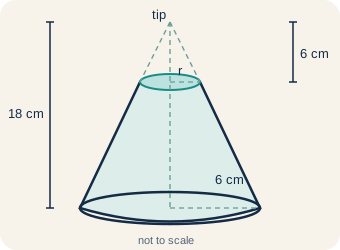
A solid right circular cone has height 18 cm and base radius 6 cm. A plane parallel to the base cuts off a smaller cone of height 6 cm at the tip. Find the radius of the new circular top face and the exact volume of the remaining solid. Find its total surface area, including both circular faces. A student multiplies the original cone's volume by 1218 because the remaining solid is 12 cm high. Explain why this is invalid.

Cone of height 18 cm and base radius 6 cm with a smaller similar tip cone of height 6 cm removed parallel to the base.
See the worked solution
  1. The removed tip cone is similar to the original cone. Its height scale is 618=13, so its radius is (13)(6)=2 cm.
  2. Full cone volume = (13)π(6²)(18)=216π cm³. Removed cone volume = (13)π(2²)(6)=8π cm³. Remaining volume = 216π−8π=208π cm³.
  3. Use Pythagoras for slant heights: original l=√(18²+6²)=6√10 cm; removed tip l=√(6²+2²)=2√10 cm.
  4. Remaining curved area = π(6)(6√10)−π(2)(2√10)=32π√10 cm². The bottom face is 36π cm² and the new top face is 4π cm².
  5. Total surface area = (32√10+40)π cm². A 1218 height fraction is not a volume fraction: the cut-off cone's volume scales by (13)³=127, and the remaining volume is 2627 of the original.

Check your reasoning: Subtract the removed cone before calculating the remaining volume and curved area; include the new circular cut face in total surface area.

Question 15

9 marks

The journey times of two groups of 40 students are grouped into 0–<10, 10–<20, 20–<30, 30–<40 and 40–<50 minutes. Group A has respective frequencies 4, p, 14, q, 2 and an estimated mean of 25 minutes. Group B has frequencies 8, 10, 10, 8, 4. Find p and q, estimate Group B's mean, and identify the median class of each group. A student claims Group A must have a higher exact median because its estimated mean is higher. Assess that claim. Finally, find the probability that a randomly chosen Group A student is in a journey-time class of at least 30 minutes.

Journey times at a glance

MinutesGroup AGroup B
0–<1048
10–<20p10
20–<301410
30–<40q8
40–<5024
See the worked solution
  1. Group A totals 40, so p+q=20. The class midpoints are 5, 15, 25, 35 and 45 minutes.
  2. Its estimated total is 40(25)=1000. Known midpoint contributions are 4(5)+14(25)+2(45)=460, so 15p+35q=540.
  3. Substitute p=20−q: 15(20−q)+35q=540, giving 20q=240. Thus q=12 and p=8; the frequencies 4+8+14+12+2 total 40.
  4. Group B's midpoint total is 8(5)+10(15)+10(25)+8(35)+4(45)=900, so its estimated mean is 90040=22.5 minutes.
  5. For 40 values the middle positions are 20 and 21. Group A cumulative frequencies are 4,12,26,38,40; Group B's are 8,18,28,36,40. Both median classes are 20–<30 minutes.
  6. The claim is not justified: grouped classes do not reveal the exact median values, and an estimated mean comparison does not determine their ordering. In Group A, 12+2=14 of 40 journeys are in classes starting at 30 minutes, so the probability is 1440=720.

Check your reasoning: A higher estimated mean does not establish a higher exact median; grouped data only locate both medians within their classes.

Prefer paper?

The same 15 questions and worked solutions are available as optional PDFs (85 marks).