Free holiday intensive · Week 2

Geometry under pressure

Choose the fact that fits the diagram, then connect it to the next step. These 12 original questions carry 54 marks; allow about 80 minutes plus review.

Before you practise

Method 1

Name the relationship before calculating

A right angle permits Pythagoras or a right-triangle ratio. Similarity needs a valid angle or side correspondence. A sketch alone does not prove either condition.

Worked example: two similar triangles have corresponding sides in the ratio 2:3. If the smaller area is 20 cm², the larger area is 20 × (32)² = 45 cm². Areas scale with the square of the length ratio.

Common mistake: Multiplying area by 32 instead of (32)².

Method 2

Choose the trigonometric rule from what is known

For two sides and their included angle, use the cosine rule for the third side. A known opposite side–angle pair permits the sine rule. When finding an angle from sine, test the supplementary angle against the triangle sum.

Worked example: sides 6 cm and 8 cm enclose 60°. The opposite side c satisfies c² = 6² + 8² − 2(6)(8)cos 60° = 52, so c = 2√13 cm.

Common mistake: Using the sine rule before a matching opposite pair is known.

Method 3

Keep angles and units attached to the geometry

A bearing is measured clockwise from north. In a circle, name the arc or chord used by an angle theorem. For a 3D solid, identify the relevant plane before applying a triangle rule.

Worked example: if a minor arc subtends 52° at the centre, it subtends 26° at a point on the opposite arc. The angle at the centre is twice the angle at the circumference standing on the same arc.

Common mistake: Pairing angles that stand on different arcs, or reading a bearing from east instead of north.

Practice

Warm-ups

Question 1

3 marks

A right triangle has perpendicular sides 9 cm and 12 cm. Find its hypotenuse and the sine of the acute angle opposite the 9 cm side.

See the worked solution
  1. Pythagoras gives hypotenuse² = 9² + 12² = 225, so the hypotenuse is 15 cm.
  2. For the specified angle, sin θ = opposite/hypotenuse = 915 = 35.

Check your reasoning: Do not use 12 cm as the opposite side when the angle is stated to face the 9 cm side.
Question 2

3 marks

Two similar triangles have corresponding side lengths in the ratio 3:5 (small:large). The smaller area is 27 cm². Find the larger area and the difference between their areas.

See the worked solution
  1. The area ratio is 3²:5² = 9:25.
  2. Larger area = 27 × 259 = 75 cm². The difference is 75 − 27 = 48 cm².

Check your reasoning: A length ratio is not an area ratio.

Practice

Core applications

Question 3

4 marks

In isosceles triangle ABC, AB = AC. The exterior angle formed by extending BC beyond C is 128°. Find all three interior angles and give a reason for each step.

See the worked solution
  1. Interior angle C and its adjacent exterior angle lie on a straight line, so C = 180° − 128° = 52°.
  2. AB = AC, so the base angles opposite them are equal: B = C = 52°.
  3. Triangle angles sum to 180°, hence A = 180° − 52° − 52° = 76°.

Check your reasoning: The given 128° is outside the triangle, not angle C.

Question 4

5 marks

Two sides of a triangle are 7 cm and 9 cm with included angle 60°. Find the third side exactly and the triangle's area exactly. State why the sine rule is not the first step for the third side.

See the worked solution
  1. No known side is paired with its opposite angle, so use the cosine rule.
  2. Third side c satisfies c² = 7² + 9² − 2(7)(9)cos 60° = 67. Thus c = √67 cm.
  3. Area = 12 × 7 × 9 × sin 60° = 63√34 cm².

Check your reasoning: The 60° angle is included between 7 and 9; it is opposite neither of those sides.

Question 5

4 marks

From a starting point, a hiker walks 6 km due north and then 8 km due east. Find the straight-line distance and bearing of the finish from the start. Give the bearing to 1 decimal place.

See the worked solution
  1. The two legs are perpendicular, so displacement = √(6² + 8²) = 10 km.
  2. Measure clockwise from north: tan θ = east/north = 86, so θ ≈ 53.1°.
  3. The bearing is 053.1°. The reverse bearing, if needed, would be 233.1°.

Check your reasoning: A bearing is measured from north, not from the eastward leg.

Question 6

5 marks

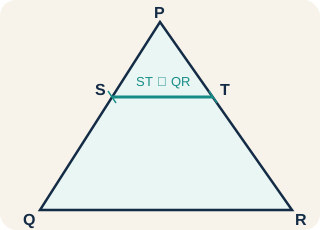
In triangle PQR, S is on PQ and T is on PR, with ST parallel to QR. Given PS:SQ = 2:3, area(PQR) = 125 cm² and QR = 15 cm, find ST and the area of trapezium SQRT.

Triangle PQR with S on PQ and T on PR; ST is parallel to QR.
See the worked solution
  1. PS:PQ = 2:(2+3) = 2:5. Parallel lines give similar triangles PST and PQR.
  2. STQR = 25, so ST = (25)(15) = 6 cm.
  3. The small-to-large area ratio is (25)² = 425. Area(PST) = 125 × 425 = 20 cm².
  4. Trapezium area = 125 − 20 = 105 cm².

Check your reasoning: Use PS:PQ, not PS:SQ, as the scale factor for the two complete triangles.

Practice

Challenging reasoning

Question 7

5 marks

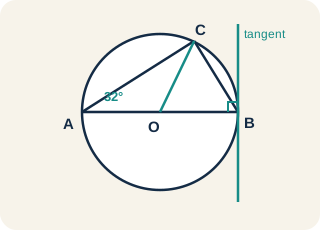
A and B are endpoints of a diameter of a circle with centre O, and C is another point on the circle. Angle BAC is 32°. Find angles ACB, ABC and the smaller central angle BOC. A tangent is drawn at B: find the acute angle between this tangent and BC using the radius–tangent right angle.

Circle with diameter AB, centre O, point C and a tangent at B; angle BAC is 32 degrees.
See the worked solution
  1. Angle ACB is subtended by diameter AB, so ACB = 90° (angle in a semicircle).
  2. Angle ABC = 180° − 90° − 32° = 58° by the triangle angle sum.
  3. The smaller central angle BOC stands on arc BC, so BOC = 2(32°) = 64° (centre angle twice circumference angle on the same arc).
  4. OB = OC, so base angle OBC = (180°−64°)2 = 58°. The tangent at B is perpendicular to radius OB; hence its acute angle with BC is 90°−58° = 32°.

Check your reasoning: Use the radius–tangent right angle and the named arc; no tangent–chord theorem is needed.

Question 8

5 marks

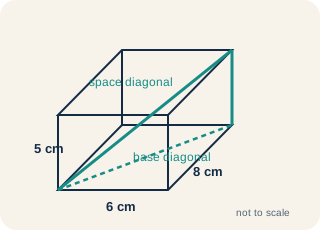
A rectangular box has length 6 cm, width 8 cm and vertical height 5 cm. Find the base diagonal, the space diagonal from one lower corner to the opposite upper corner, and the angle that the space diagonal makes with the horizontal base. Give the angle to 1 decimal place.

Rectangular box with labelled 6 cm length, 8 cm width and 5 cm height, showing base and space diagonals.
See the worked solution
  1. In the base plane, diagonal = √(6² + 8²) = 10 cm.
  2. The space diagonal is the hypotenuse of a right triangle with horizontal side 10 and vertical side 5: √(10² + 5²) = 5√5 cm.
  3. For the angle with the base, tan θ = vertical/horizontal = 510, so θ ≈ 26.6°.

Check your reasoning: Use the base diagonal, not a single box edge, as the horizontal side of the final triangle.

Question 9

5 marks

In triangle ABC, angle A = 30°, BC = 6 cm and AC = 10 cm. Find every possible value of angle B to 1 decimal place. Explain whether both values form a valid triangle.

See the worked solution
  1. BC is opposite A and AC is opposite B. Sine rule gives sin B10 = sin 30°/6, so sin B = 56.
  2. The acute solution is B ≈ 56.4°. The supplementary solution is B ≈ 123.6°.
  3. Their respective third angles are 180° − 30° − 56.4° = 93.6° and 180° − 30° − 123.6° = 26.4°. Both are positive, so both triangles are valid.

Check your reasoning: Inverse sine returns one angle; check its supplement when the given information is side–side–angle.

Practice

Misconception analysis

Question 10

4 marks

In triangle ABC, AB = 5 cm and AC = 7 cm enclose angle BAC = 60°. A student writes 5sin 60° = 7sin B to find BC. Identify the first invalid step and find BC correctly.

See the worked solution
  1. AB = 5 cm is opposite angle C, not angle A = 60°. The student has mismatched a side and angle; no known opposite pair is available yet.
  2. Use the cosine rule for BC: BC² = 5² + 7² − 2(5)(7)cos 60° = 39.
  3. Hence BC = √39 cm (about 6.24 cm).

Check your reasoning: Always mark the side opposite each angle before writing a sine-rule ratio.

Practice

Stretch

Question 11

5 marks

A circle has radius 6 cm. A minor sector has central angle 120°. Find its arc length, sector area and the area of the minor segment bounded by the chord, all exactly.

See the worked solution
  1. Convert 120° to 2π3 radians. Arc length = rθ = 6(2π3) = 4π cm.
  2. Sector area = (12)r²θ = (12)(36)(2π3) = 12π cm².
  3. The triangle formed by the two radii has area (12)(6)(6)sin 120° = 9√3 cm².
  4. Minor segment area = sector − triangle = 12π − 9√3 cm².

Check your reasoning: Subtract the triangle from the sector for the minor segment; do not subtract the entire circle.

Question 12

6 marks

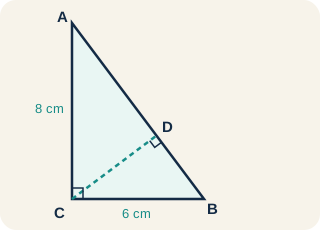
Triangle ABC is right-angled at C, with AC = 8 cm and BC = 6 cm. D lies on hypotenuse AB and CD is perpendicular to AB. Find AB, AD, DB and CD. Show that AD×DB = CD² and explain which similar triangles justify the result.

Right triangle ABC with 8 cm and 6 cm legs; altitude CD is perpendicular to hypotenuse AB.
See the worked solution
  1. Pythagoras gives AB = √(8²+6²) = 10 cm.
  2. Triangles ACD, CBD and ABC are similar by their matching acute angles and right angles. In ACD and ABC, ADAC = ACAB, so AD = 8²10 = 6.4 cm. In CBD and ABC, DBBC = BCAB, so DB = 6²10 = 3.6 cm.
  3. The area of ABC is (12)(8)(6) = 24 cm², also (12)(10)(CD). Hence CD = 4.8 cm.
  4. Triangles ACD and CBD also give ADCD = CDDB, so AD×DB = CD². Check numerically: 6.4×3.6 = 23.04 = 4.8², and AD+DB = 10 cm.

Check your reasoning: The perpendicular altitude CD is not the midpoint of AB; derive segment lengths from similarity, then check they sum to AB.

Prefer paper?

The same 12 questions and worked solutions are available as optional PDFs (54 marks).