Mixed practice · Upper Secondary · G3 Mathematics
Final Push Mini Check
Seven original mixed questions for a short final review, with complete worked solutions.
At a glance
- Level
- Upper Secondary · G3 Mathematics
- Focus
- Mixed review
- Time
- About 20–30 minutes
- Format
- Seven questions
Complete practice set
Show your working. Give non-exact numerical answers to 3 significant figures unless otherwise stated. Questions 1–3 use familiar methods; in 4–5, choose the approach; in 6, question the obvious answer; and in 7, organise a multi-step problem.
Download the complete PDF ↓Questions
Question 01
A quadratic curve has equation y = x² + bx + c. Its x-intercepts are −2 and 6. Find its minimum point.
Question 02
Two fair six-sided dice are rolled. A student records the larger score (recording that score once if the dice agree). Find the probability that the recorded score is 4.
Question 03
Before rounding to the nearest cent, a bill has a 9% service charge and then a 5% discount on the resulting amount. The calculated amount is $93.195. Find the original bill b. Is the net change a 4% increase? Explain.
Question 04
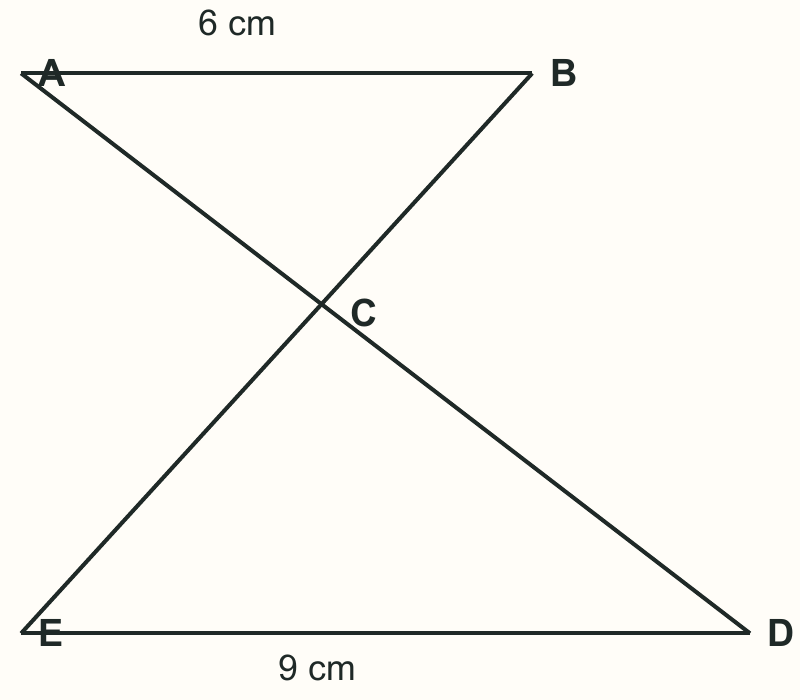
AB and DE are parallel segments with lengths 6 cm and 9 cm. Lines AD and BE cross at C, with C between A and D and between B and E. Given that AC = 8 cm, find CD. Give geometrical reasons for your working.
Question 05
In triangle ABC, AB = 12 cm, AC = 8 cm and angle ABC = 30°. Find all possible values of angle ACB. Explain why the information does not determine a unique triangle. Do not calculate any side lengths.
Question 06
(a) A cyclist travels the first half of a route at 12 km/h and the second half at 18 km/h. Find the average speed. (b) Rice costing 12/kg and rice costing 18/kg are bought in equal dollar amounts. Find the average cost per kilogram of the combined purchase. Explain why 15 is not the answer to either part.
Question 07
A school is arranging an outing for n pupils, where n is an integer from 100 to 140. Two packages are available. A: Coaches seat 36 and cost $150 each. Admission costs $12 per pupil, reduced to $10 for every pupil if at least 120 attend. B: Each package costs $590 and includes a 40-seat coach and admission for up to 40 pupils. Partly filled coaches cost the full amount. (a) Find the cheaper option for 117 pupils. (b) Find all values of n for which A is cheaper than B. Justify your answer. (c) With a budget of $1900, find the greatest number of pupils who can attend and state the package.
Worked solutions
Try each question before opening its solution. In print, all solutions are shown.
Question 01 · reveal solution
- Step 1
The intercepts give the factorised form directly: y = (x + 2)(x − 6).
- Step 2
= x² − 4x − 12 = (x − 2)² − 16.
- Step 3
The square term is smallest when x = 2.
Answer: (2, −16)
If this broke, look here first: Start with the x-intercepts → factors → turning point.
Question 02 · reveal solution
- Step 1
For the recorded score to be 4, both dice must be at most 4, but they cannot both be at most 3.
- Step 2
Number of favourable outcomes = 4² − 3² = 7.
- Step 3
There are 7 favourable outcomes from 36 equally likely outcomes.
Answer: 7/36
If this broke, look here first: “Largest score is 4” means both dice ≤ 4, but not both ≤ 3.
Question 03 · reveal solution
- Step 1
0.95(1.09b) = 93.195.
- Step 2
b = 93.195 ÷ (0.95 × 1.09) = 90.
- Step 3
The overall multiplier is 1.09 × 0.95 = 1.0355, so it is not a 4% increase.
Answer: Original bill = $90; net increase = 3.55%
If this broke, look here first: Turn each percentage into a multiplier and apply them in order.
Question 04 · reveal solution
- Step 1
∠ACB = ∠DCE (vertically opposite angles) and ∠CAB = ∠CDE (alternate angles). Therefore triangles ACB and DCE are similar.
- Step 2
AC/CD = AB/DE = 6/9, so 8/CD = 6/9.
- Step 3
CD = 12 cm.
Answer: CD = 12 cm
If this broke, look here first: Establish the equal angles before using the lengths.
Question 05 · reveal solution
- Step 1
Using the sine rule: sin C / 12 = sin 30° / 8, so sin C = 3/4.
- Step 2
The calculator gives C = 48.590…°.
- Step 3
Since sine is also positive in the second quadrant, C may also be 180° − 48.590…° = 131.409…°.
- Step 4
Both values leave a positive third angle when added to 30°, so both triangles are possible.
Answer: Angle ACB = 48.6° or 131°
If this broke, look here first: Check whether a second angle is possible after applying the sine rule.
Question 06 · reveal solution
- Step 1
(a) Take a 36 km route. The time is 18/12 + 18/18 = 2.5 h, and average speed = 36/2.5 = 14.4 km/h.
- Step 2
(b) Spend $36 on each type. The mass is 36/12 + 36/18 = 5 kg, and average cost = 72/5 kg = 14.40/kg.
- Step 3
The quantities are not equally weighted, so the arithmetic mean 15 is not valid in either part.
Answer: (a) 14.4 km/h; (b) $14.40/kg
If this broke, look here first: Work out the correct weighting before choosing a formula.
Question 07 · reveal solution
- Step 1
(a) For 117 pupils, A needs four coaches and B needs three packages. Cost of A = 4(150) + 117(12) = $2004. Cost of B = 3(590) = $1770. Package B is cheaper.
- Step 2
For part (b), split the range wherever a coach count or the admission price changes: after 108 pupils, at 120 pupils, and after 120 pupils.
Pupils n Cost A ($) Cost B ($) Cheaper 100 to 108 450 + 12n 1770 A 109 to 119 600 + 12n 1770 B 120 1800 1770 B 121 to 140 600 + 10n 2360 A - Step 3
Therefore A is cheaper for 100 ≤ n ≤ 108 or 121 ≤ n ≤ 140.
- Step 4
(c) Above 120 pupils, B costs $2360 and exceeds the budget. Under A: 600 + 10n ≤ 1900, so n ≤ 130. At n = 130, A costs exactly $1900. Hence the greatest possible number is 130 pupils, using package A.
Answer: (a) B; (b) 100 ≤ n ≤ 108 or 121 ≤ n ≤ 140; (c) 130 pupils, package A
If this broke, look here first: Split into cases whenever a coach count or admission price changes.
Transcribed from Mentora O-Level E-Math Final Push, 9 pages. The downloadable PDF retains the original authored page layout.
Keep practising with
- Upper Sec Mixed Check #01A varied check where the question heading does not tell you which method to use.
- Prelim Paper Autopsy #01A closer look at common sticking points in the 2026 prelim paper — and what you can learn from them.
- Prelim Repair #01Worked through the paper breakdown? Try six questions designed to strengthen the skills covered.