Mixed practice · Secondary 3–4
Upper Sec Mixed Check #01
A varied check where the question heading does not tell you which method to use.
At a glance
- Level
- Secondary 3–4
- Focus
- Mixed · revise core methods
- Time
- About 25–30 minutes
- Format
- 12 questions
Complete practice set
Try every question before opening the solutions. Show your working, use a calculator as needed, and use degree mode for angles. Give exact answers unless a question requests rounding.
Download the complete PDF ↓Questions
Question 01
3 marksSimplify 3(4a + 6b) − 2(2a + 3b), then factorise your result fully.
Question 02
3 marksTriangle RST is right-angled at S. Angle R is 38° and ST = 7 cm. Find RT, correct to 3 significant figures.
Question 03
2 marksThe marks of seven students are shown below. Find the mean mark, correct to 2 decimal places.
Marks of the seven students 6 13 16 32 33 34 36 Question 04
2 marksFactorise 8mn − 12m fully.
Question 05
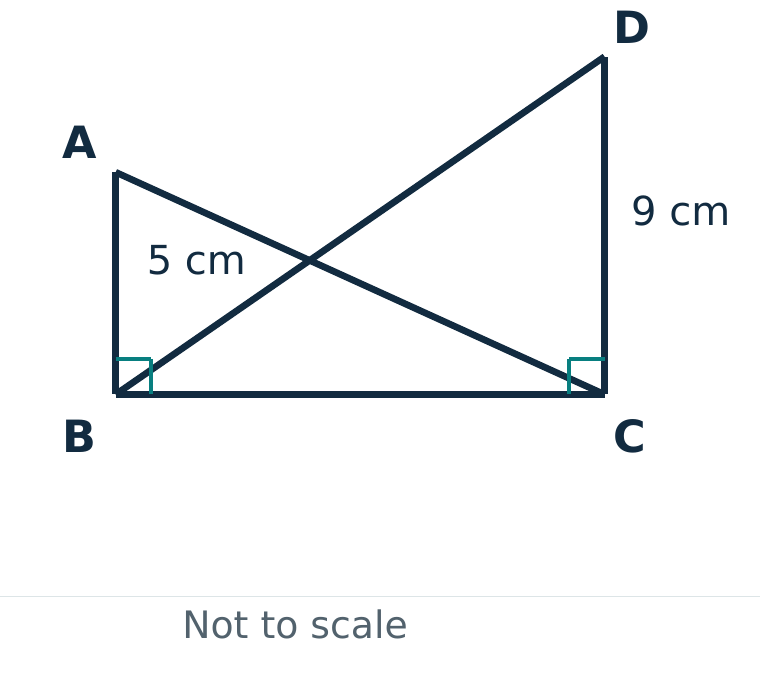
4 marksThe diagram shows two right-angled triangles ABC and BCD in the same plane. The right angles are at B and C. AC = 13 cm, AB = 5 cm and CD = 9 cm. Find angle CBD, correct to 1 decimal place.
Question 06
3 marksThirty identical tokens are numbered consecutively from 18 to 47. One token is chosen at random. Find the probability that its number is a multiple of 4. Give your answer in simplest form.
Question 07
3 marksFactorise 6p² − 24q² fully.
Question 08
3 marksFactorise 3x² − 11x − 4 fully.
Question 09
4 marksA box contains 81 identical cards. The numbers of red, blue and green cards are in the ratio 2 : 3 : 4, in that order. One card is chosen at random; every card is equally likely. Find the probability that it is red or green. Give your answer in simplest form.
Question 10
3 marksFind the simplified expression for the excess of 6(2t − 1) over 3t + 8.
Question 11
4 marksFor nonzero m and n, E = 12/(mn). A student writes n = 12m/E. Explain the error, make n the subject, and state the value E cannot take.
Question 12
4 marksSix results are 2, 4, 4, 6, 9 and 11. One of the six result cards is chosen at random, with each card equally likely. Find the probability that the chosen result is greater than the mean of all six results.
Worked solutions
Try each question before opening its solution. In print, all solutions are shown.
Question 01 · reveal solution
- Step 1Expand both brackets
3(4a + 6b) − 2(2a + 3b) = 12a + 18b − 4a − 6b
- Step 2Collect like terms
= 8a + 12b
- Step 3Factorise fully
The greatest common factor is 4. 8a + 12b = 4(2a + 3b)
Answer: 4(2a + 3b)
If this broke, look here first: check whether your expanded and simplified expression is correct before trying to factorise it.
Question 02 · reveal solution
- Step 1Identify the sides relative to 38°
ST = 7 cm is opposite angle R. RT is the hypotenuse.
- Step 2Choose the ratio
sin 38° = opposite / hypotenuse. sin 38° = 7 / RT.
- Step 3Rearrange and calculate
RT = 7 / sin 38° = 11.370… cm
Answer: 11.4 cm (3 s.f.)
If this broke, look here first: identifying the opposite side and hypotenuse before choosing the ratio.
Question 03 · reveal solution
- Step 1Add all seven marks
6 + 13 + 16 + 32 + 33 + 34 + 36 = 170
- Step 2Divide by the number of students
Mean = 170 / 7 = 24.285714…
- Step 3Round only at the end
To 2 decimal places, 24.285714… becomes 24.29.
Answer: 24.29 (2 d.p.)
If this broke, look here first: checking that all seven marks are included in the total before dividing.
Question 04 · reveal solution
- Step 1Find the greatest common factor
HCF(8, 12) = 4. Both terms also contain m. The greatest common monomial factor is 4m.
- Step 2Divide each term
8mn ÷ 4m = 2n; −12m ÷ 4m = −3. 8mn − 12m = 4m(2n − 3).
Answer: 4m(2n − 3)
If this broke, look here first: including m in the common factor and dividing both terms.
Question 05 · reveal solution
- Step 1Find BC in triangle ABC
ABC is right-angled at B; AC = 13 cm is the hypotenuse. BC² = AC² − AB² = 13² − 5². BC² = 169 − 25 = 144, so BC = 12 cm.
- Step 2Move to triangle BCD
For angle CBD, opposite = CD = 9 cm. Adjacent = BC = 12 cm.
- Step 3Choose the ratio
tan(CBD) = 9 / 12
- Step 4Find the angle
CBD = tan⁻¹(9/12) = 36.869…°
Answer: 36.9° (1 d.p.)
If this broke, look here first: finding the shared side with Pythagoras before selecting the angle ratio.
Question 06 · reveal solution
- Step 1Count all possible tokens
The endpoints are included: 47 − 18 + 1 = 30.
- Step 2List valid multiples of 4
20, 24, 28, 32, 36, 40, 44. There are 7 favourable tokens.
- Step 3Form the probability
P(multiple of 4) = 7/30
Answer: 7/30
If this broke, look here first: counting both endpoints in the total, then listing multiples inside the range.
Question 07 · reveal solution
- Step 1Take out the greatest common factor
6p² − 24q² = 6(p² − 4q²)
- Step 2Recognise the difference of squares
p² − 4q² = p² − (2q)²
- Step 3Factorise the bracket
p² − (2q)² = (p − 2q)(p + 2q)
Answer: 6(p − 2q)(p + 2q)
If this broke, look here first: taking out the common factor before checking the bracket for two squares.
Question 08 · reveal solution
- Step 1Find two terms for the middle
Product = 3 × (−4) = −12; sum = −11. Use −12 and +1.
- Step 2Split the middle term
3x² − 11x − 4 = 3x² − 12x + x − 4
- Step 3Factor by grouping
= 3x(x − 4) + 1(x − 4)
- Step 4Take out the common bracket
= (3x + 1)(x − 4)
Answer: (3x + 1)(x − 4)
If this broke, look here first: finding two numbers with product −12 and sum −11 before splitting the middle term.
Question 09 · reveal solution
- Step 1Count the ratio parts
2 + 3 + 4 = 9 parts
- Step 2Find one part
81 ÷ 9 = 9 cards per part
- Step 3Count favourable cards
Red: 2 × 9 = 18; green: 4 × 9 = 36. Red or green: 18 + 36 = 54 cards.
- Step 4Form the probability
P(red or green) = 54/81 = 2/3
Answer: 2/3
If this broke, look here first: using the ordered ratio to identify the two favourable colours.
Question 10 · reveal solution
- Step 1Translate the wording
“The excess of A over B” means A − B. Write 6(2t − 1) − (3t + 8).
- Step 2Expand carefully
= 12t − 6 − 3t − 8
- Step 3Collect like terms
= 9t − 14
Answer: 9t − 14
If this broke, look here first: translating “excess of A over B” as A − B, with brackets around B.
Question 11 · reveal solution
- Step 1Identify the student’s error
m is in the original denominator. It must stay in the denominator when n is isolated.
- Step 2Clear the fraction
E = 12/(mn). Multiply both sides by mn: Emn = 12.
- Step 3Make n the subject
Divide both sides by Em: n = 12/(Em).
- Step 4State the restriction on E
Since m and n are nonzero, 12/(mn) cannot be 0. Therefore E ≠ 0.
Answer: n = 12/(Em), E ≠ 0
If this broke, look here first: checking where m belongs when isolating n from Emn = 12.
Question 12 · reveal solution
- Step 1Find the mean
Total = 2 + 4 + 4 + 6 + 9 + 11 = 36. Mean = 36 ÷ 6 = 6.
- Step 2Apply the condition
Only 9 and 11 are greater than 6. The result equal to 6 does not qualify.
- Step 3Form the probability
2 favourable cards out of 6: 2/6 = 1/3
Answer: 1/3
If this broke, look here first: finding the mean first, then treating “greater than” as a strict condition.
Transcribed from Upper Sec G3 E-Math Mixed Check #01 V4, 14 pages. The downloadable PDF retains the original authored page layout.
Keep practising with
- Prelim Paper Autopsy #01A closer look at common sticking points in the 2026 prelim paper — and what you can learn from them.
- Prelim Repair #01Worked through the paper breakdown? Try six questions designed to strengthen the skills covered.
- Final Push Mini CheckSeven original mixed questions for a short final review, with complete worked solutions.