Original repair practice · Secondary 4
Prelim Repair #01
Worked through the paper breakdown? Try six questions designed to strengthen the skills covered.
At a glance
- Level
- Secondary 4
- Focus
- Focused repair · three skill areas
- Time
- Short focused practice
- Format
- Six original questions
Complete practice set
Six original Mentora questions across compound inequalities, without-replacement probability and speed–time graphs. Inspired by selected breakpoints from NCHS 2026 Prelim Paper 1 (Mathematics 4052); these are Mentora-authored questions, not NCHS questions.
Download the complete PDF ↓Questions
Question 01
4 marksCompound inequalities
Solve the inequality below and represent its solution on a number line.
x-23<5-2x4≤x+72
Question 02
4 marksCompound inequalities
Solve the inequality below and represent its solution on a number line.
-1≤3-x-22<4
Question 03
4 marksWithout replacement
A bag contains 7 red counters and n green counters. Two counters are drawn at random, one after the other without replacement. The probability that both counters are green is 5/33. Find n.
Question 04
4 marksWithout replacement
A box contains 5 blue counters and 3 yellow counters. Two counters are selected at random without replacement. Find the probability that exactly ONE of the two counters is yellow.
Question 05
3 marksSpeed–time graphs
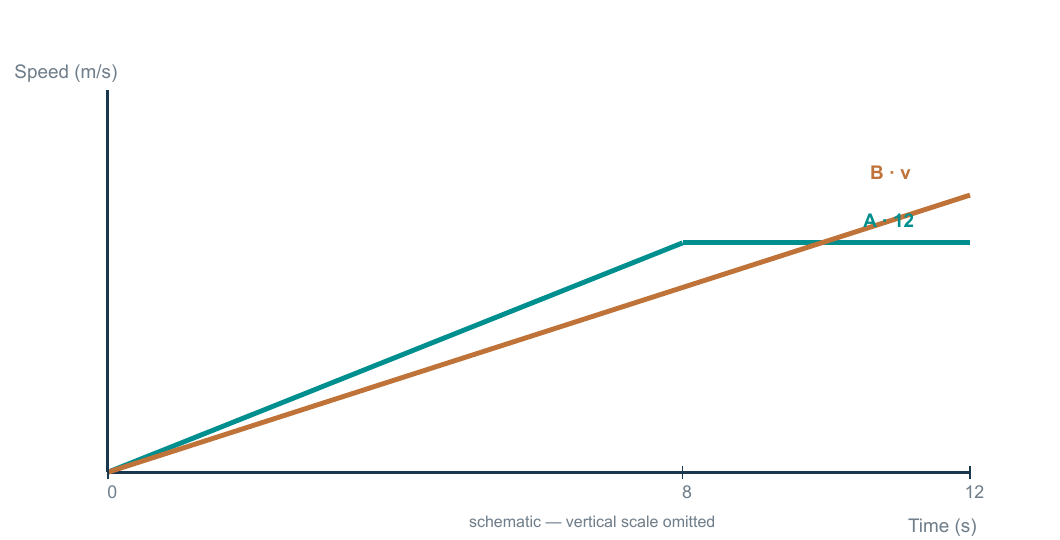
Cyclist A starts from rest, accelerates uniformly to 12 m/s in 8 s, then continues at 12 m/s until t = 12 s. Cyclist B starts from the same point at the same time and accelerates uniformly from rest over 12 s. At t = 12 s, Cyclist B catches Cyclist A. Find v.
Question 06
4 marksSpeed–time graphs
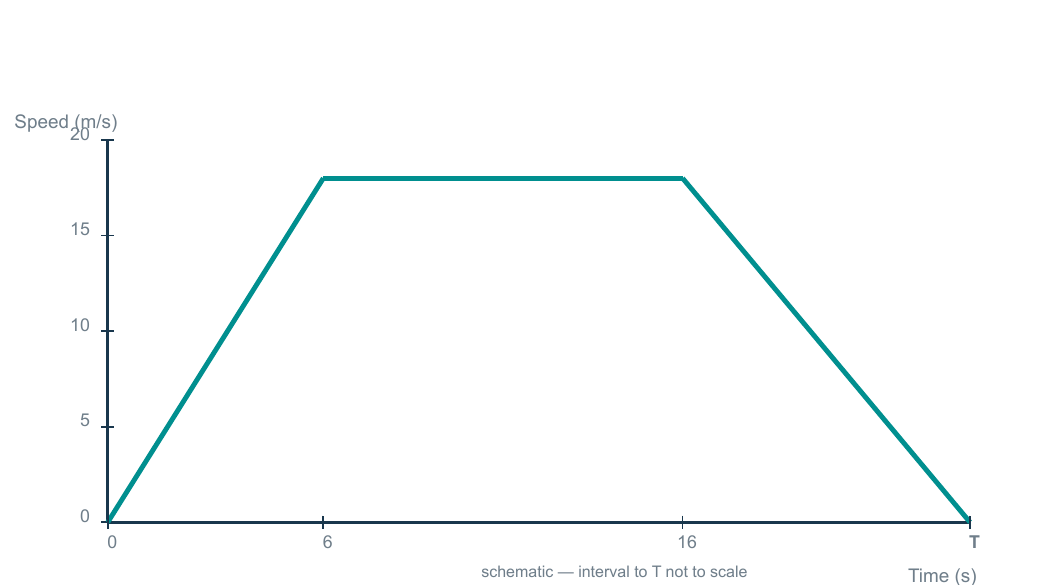
A vehicle accelerates uniformly from rest to 18 m/s in 6 s, travels at 18 m/s for the next 10 s, then decelerates uniformly to rest. The total distance travelled is 270 m. Find (a) the time spent decelerating; (b) the total journey time.
Worked solutions
Try each question before opening its solution. In print, all solutions are shown.
Question 01 · reveal solution
- Step 1Split the compound inequality
x-23<5-2x4 and 5-2x4≤x+72
- Step 2Multiply the first inequality by 12
4(x-2)<3(5-2x)
- Step 3Expand
4x-8<15-6x
- Step 4Collect x terms
10x<23
- Step 5Upper bound
x<2310
- Step 6Multiply the second inequality by 4
5-2x≤ 2x+14
- Step 7Collect x terms
-9≤ 4x
- Step 8Lower bound
-94≤ x
- Step 9Combine both conditions
-94≤ x<2310; the lower endpoint is closed and the upper endpoint is open.
Answer: −9/4 ≤ x < 23/10
If this broke, look here first:
- First inequality differs before x < 23/10 → multiplying through by 12 or collecting x terms; 12 is positive, so the sign direction stays unchanged.
- Second inequality differs before x ≥ −9/4 → expanding 5 − 2x ≤ 2x + 14 and dividing by +4; the endpoint is included.
- Both bounds correct but endpoint/number line differs → −9/4 is closed (≤) and 23/10 is open (<).
Question 02 · reveal solution
- Step 1Split into two inequalities
-1≤3-x-22 and 3-x-22<4
- Step 2Subtract 3
-4≤-x-22
- Step 3Multiply by −2 and reverse the sign
8≥ x-2
- Step 4Isolate x
x≤10
- Step 5Solve the upper condition separately
-x-22<1
- Step 6Multiply by −2 and reverse the sign
x-2>-2
- Step 7Isolate x
x>0
- Step 8Combine both conditions
0<x≤10; the endpoint at 0 is open and at 10 is closed.
Answer: 0 < x ≤ 10
If this broke, look here first:
- Lower condition first diverges when multiplying by −2 → reverse ≤ to ≥; that gives x ≤ 10.
- Upper condition first diverges when multiplying by −2 → reverse < to >; that gives x > 0.
- One condition is absent or the interval is joined incorrectly → solve both parts and take their intersection.
- Endpoint at 0 or 10 differs → 0 is open, 10 is closed.
Question 03 · reveal solution
- Step 1Probability first green
nn+7
- Step 2Update counts after one green is drawn
After one green is drawn: n-1n+6
- Step 3Set equal to the given probability
nn+7×n-1n+6=533
- Step 4Cross-multiply
33n(n-1)=5(n+7)(n+6)
- Step 5Expand both sides
33n2-33n=5n2+65n+210
- Step 6Collect terms
28n2-98n-210=0
- Step 7Simplify by 14
2n2-7n-15=0
- Step 8Factorise
(2n+3)(n-5)=0
- Step 9Solve and check the context
n=-32 or n=5. Reject the negative root because a counter count cannot be negative.
Answer: n = 5
If this broke, look here first:
- Second denominator is n + 7 → after one green is removed, n + 6 counters remain.
- Second numerator is n → after one green is removed, n − 1 green counters remain.
- The negative root n = −3/2 is impossible for a counter count; keep n = 5.
Question 04 · reveal solution
- Step 1Count Yellow then Blue
P(Y then B)=38×57=1556
- Step 2Count Blue then Yellow
P(B then Y)=58×37=1556
- Step 3Add the mutually exclusive orders
P(exactly one yellow)=1556+1556=1528
Answer: 15/28
If this broke, look here first:
- Only one order is present → exactly one yellow can occur as Y–B or B–Y.
- Second denominator is still 8 → after the first selection, 7 counters remain.
- Second numerator does not reflect the first selection → update the remaining colour counts.
Question 05 · reveal solution
- Step 1Same start; at catch-up they are together, so distances are equal
s_A=s_B
- Step 2Find Cyclist A’s distance: triangle plus rectangle
s_A=12(8)(12)+(12-8)(12)=48+48=96 m
- Step 3Find Cyclist B’s distance: triangle
s_B=12(12)v=6v
- Step 4Equate distances and solve
6v=96, so v=16 m/s
Answer: v = 16 m/s
If this broke, look here first:
- Set v = 12 immediately → catch-up means equal distance at that instant, not equal speed; B’s speed is v while A’s is 12 m/s.
- Used graph height as distance → distance is area under each speed–time graph.
- A’s area differs → split at 8 s into a triangle and a 4 s rectangle.
Question 06 · reveal solution
- Step 1Acceleration triangle area
s_1=12(6)(18)=54 m
- Step 2Constant-speed rectangle area
s_2=(10)(18)=180 m
- Step 3Find the remaining distance
s_{remaining}=270-54-180=36 m
- Step 4Use the deceleration triangle
12(t)(18)=36, so 9t=36 and t=4 s
- Step 5Add the three time intervals
T=6+10+4=20 s
Answer: (a) 4 s; (b) 20 s
If this broke, look here first:
- Treated 18 m/s as a distance → use area under the graph.
- Rectangle width is 16 s → the constant-speed interval is the next 10 s; deceleration begins at t = 16 s.
- Did not subtract the first two areas from 270 m → 36 m remains for the deceleration triangle.
- Final time differs → add 6 s + 10 s + deceleration time.
Transcribed from Prelim Repair #01 G3 Mathematics final, 16 pages; editable question transcript and math.json. The downloadable PDF retains the original authored page layout.
Keep practising with
- Upper Sec Mixed Check #01A varied check where the question heading does not tell you which method to use.
- Prelim Paper Autopsy #01A closer look at common sticking points in the 2026 prelim paper — and what you can learn from them.
- Final Push Mini CheckSeven original mixed questions for a short final review, with complete worked solutions.