Paper review · Secondary 4 · 2026 prelim context
Prelim Paper Autopsy #01
A closer look at common sticking points in the 2026 prelim paper — and what you can learn from them.
At a glance
- Level
- Secondary 4 · 2026 prelim context
- Focus
- Exam review · selected questions
- Time
- Work through at your own pace
- Format
- Six selected question discussions
Six questions, worked solutions and breakpoints
Questions from Nan Chiau High School's 2026 Secondary 4 E-Math Preliminary Examination, Paper 1. Worked explanations and breakpoint notes are by Mentora.
Try each complete question before opening its worked solution. Compare your method with the steps to find where your working first changed course.
Q12 · Compound inequalities
[4]Solve the inequalities
x-12<5-2x3≤ 2-x-34
and represent the solutions on the number line below.

Work on the two sides of the chain separately, then intersect the results. Keep each strict or inclusive sign attached to its own bound.
View worked solution
Worked reasoning
- Split the chain: x-12<5-2x3 and 5-2x3≤ 2-x-34.
- Multiply the left inequality by positive 6: 3(x-1)<2(5-2x).
- Expand and collect: 3x-3<10-4x.
- Isolate x: 7x<13.
- The upper bound is x<137.
- Multiply the right inequality by positive 12: 4(5-2x)le24-3(x-3).
- Expand and collect: 20-8xle33-3x.
- Isolate x: -13le5x.
- The lower bound is x≥-135.
- Intersect the bounds: -135≤ x<137. The lower endpoint is included; the upper endpoint is not.
Final answer: -135≤ x<137
Where students get stuck
- If the two bounds do not meet correctly, check how you split the chain.
- A sign reverses only when multiplying or dividing by a negative number; the final division here is by positive 5.
- If the interval is right but its endpoints are wrong, revisit < versus ≤.
What to practise next: Practise splitting a three-part inequality and marking open and closed endpoints before combining the bounds.
Q15 · Probability without replacement
[4]A bag contains 5 red marbles and n green marbles. Two marbles are drawn at random from the bag, one after the other without replacement. Given that the probability of drawing 2 green marbles is 311, find the value of n.
After one green marble is drawn, both the number of green marbles and the total number of marbles decrease by one.
View worked solution
Worked reasoning
- The first green probability is nn+5.
- After one green marble is removed, the conditional second green probability is n-1n+4.
- Set their product equal to the given probability: nn+5×n-1n+4=311.
- Cross-multiply: 11n(n-1)=3(n+5)(n+4).
- Expand: 11n2-11n=3n2+27n+60.
- Collect terms: 8n2-38n-60=0.
- Simplify: 4n2-19n-30=0.
- Factorise: (4n+5)(n-6)=0.
- The roots are n=-54 and n=6.
- A marble count cannot be negative, so retain n=6.
Final answer: n=6
Where students get stuck
- If the second total remains n+5, revisit without-replacement probability.
- If the second green count remains n, update the favourable outcomes after the first draw.
- If the quadratic differs, check expansion and factorisation before solving.
- Check every algebraic root against the counting context.
What to practise next: Set up two-stage probability problems with a changed numerator and denominator after the first draw.
Q20 · Similar cones and volume
[5]The diagram shows a flower pot of height 12 cm. It is obtained when a smaller cone of height h cm and base radius 4 cm is removed from a larger cone with base radius 10 cm. Jack filled the pot to two-third of its height and commented that the pot is filled to two-third of its volume. Do you agree with Jack? Support your answer with appropriate workings.
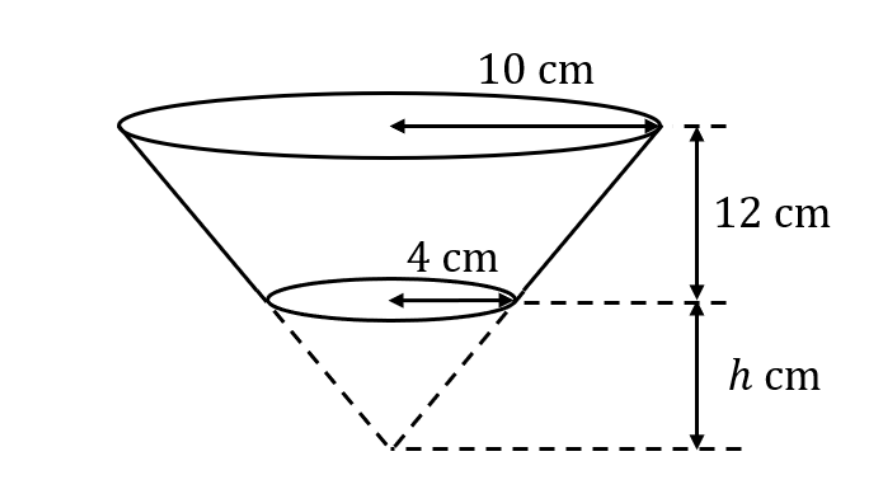
Use corresponding radii to locate the removed cone, then find the pot and filled volumes by subtraction. A fraction of height is not the same as a fraction of volume.
View worked solution
Worked reasoning
- Use similarity to find the full cone dimensions: hH=frac4{10}, so H=2.5h.
- Use the frustum height: H-h=12, hence h=8 cm and H=20 cm.
- Subtract the removed cone from the full cone: V_{pot}=13π(102)(20)-13π(42)(8).
- Evaluate the pot volume: V_{pot}=624π cm3.
- Two-thirds of the pot's 12 cm height is 8 cm above its base. The radius there is r=4+frac8{12}(10-4)=8 cm.
- The corresponding cone height from the apex to the fill surface is H_{fill}=20-4=16 cm.
- Subtract the same removed cone: V_{fill}=13π(82)(16)-13π(42)(8).
- Evaluate the filled volume: V_{fill}=896π3 cm3.
- Compare volumes: V_{fill}V_{pot}=56117=47.9%.
- Because 47.9%≠66.7%, Jack's claim is incorrect.
Final answer: The filled volume is 47.9% of the pot; the two-thirds volume claim is incorrect.
Where students get stuck
- If the cone dimensions differ, pair corresponding linear measures before using H-h=12.
- The pot is a large cone minus a small cone.
- Volume depends on r2h, so a height tion cannot be used directly as a volume tion.
- For filled volume, subtract the removed cone before dividing by total pot volume.
What to practise next: Practise similar-cone scale factors and cone-volume subtraction before comparing fractions.
Q22 · Speed–time graphs
(a) [2] · (b) [1] · (c) [1]The diagram shows the speed-time graphs of a car and a motorcycle, travelling from point A to point B along the same road. The car accelerates uniformly from rest for the first 25 seconds. The motorcycle accelerates uniformly from rest for 10 seconds and then travelled at a constant speed of v m/s before it decelerates uniformly to a stop in the next 16 seconds.
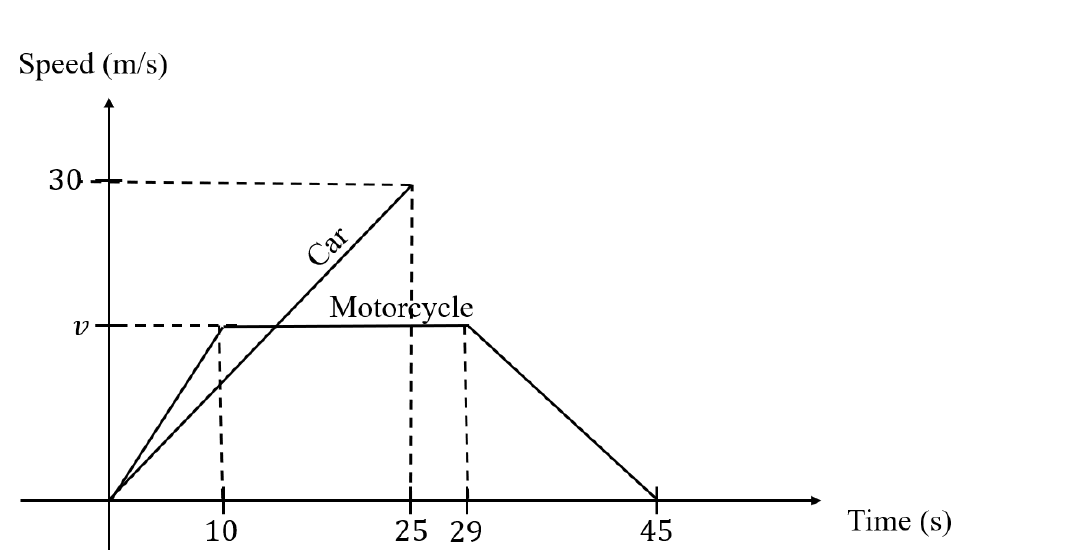
(a) Given that the car overtakes the motorcycle at t = 25 seconds, find the value of v. [2]
(b) Given that the car decelerates uniformly after t = 25 seconds before it comes to a stop at B. Calculate the time taken for the car to decelerate uniformly to a stop at point B. [1]
(c) On the above speed-time graph, sketch the remaining portion of the car’s journey until it comes to a stop. [1]
Read distance as area under each speed–time graph. At the overtaking time, the two cumulative distances are equal, even though their speeds need not be.
View worked solution
Worked reasoning
- At the overtaking time t=25 s, the car and motorcycle have travelled equal distances.
- The car's triangular area to 25 s is s_{car}=12(25)(30)=375 m.
- For the motorcycle to 25 s, add the initial triangle and the constant-speed rectangle: s_{motorcycle}=12(10)v+(25-10)v=20v.
- Equate distances: 20v=375, giving v=18.75 m/s.
- The motorcycle's whole-journey area is 12(10)v+(29-10)v+12(45-29)v=32v=600 m.
- The car has 600-375=225 m left to travel.
- Its deceleration triangle gives 12(30)t=225, so t=15 s.
- Complete the car graph with a straight descending segment from (25,30) to (40,0).
Final answer: v=18.75 m/s; car deceleration time 15 s; graph endpoint (40,0).
Where students get stuck
- Overtaking means equal distance at that instant, not equal speed.
- Graph height is speed; area under the graph is distance.
- Separate triangles and rectangles at their actual time boundaries.
- The car and motorcycle cover the same A-to-B distance.
What to practise next: Practise splitting a speed–time graph into simple areas and relating those areas to a shared journey.
Q24 · Circle geometry
(a) [3] · (b) [1] · (c) [2]P, Q and R are points on the circumference of a circle with centre O. The radius of the circle is 5 m, angle QPR = 38° and angle ORP = 22°.
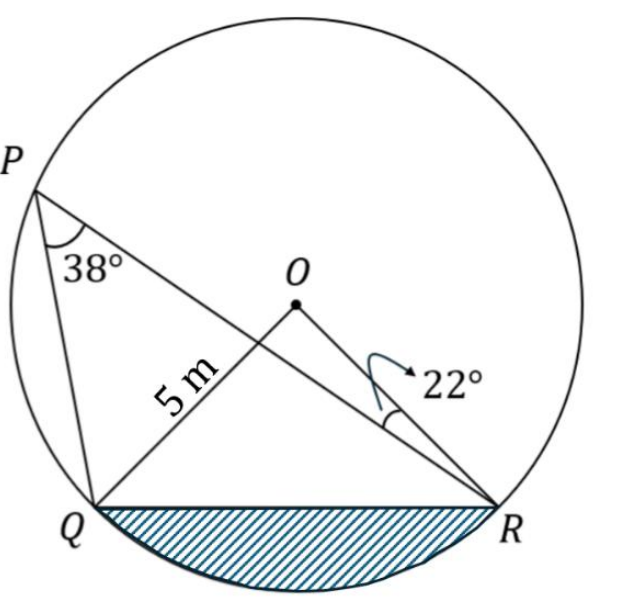
(a) Find angle OQP. Give a reason for each step of your working. [3]
(b) Explain if it is possible to draw a circle passing through points O, Q and R, with QR as the diameter. [1]
(c) Calculate the area of the shaded segment. [2]
Begin with equal radii, name each angle reason, then compare the central angle with the angle required by a semicircle. Segment area is sector area minus triangle area.
View worked solution
Worked reasoning
- Because OP=OR, triangle OPR is isosceles: ∠ OPR=∠ ORP=22°.
- Adjacent angles at P give ∠ OPQ=∠ OPR+∠ RPQ=22°+38°=60°.
- Because OP=OQ, triangle OPQ is isosceles: ∠ OQP=∠ OPQ=60°.
- The angle at the centre is twice the angle at the circumference on the same arc: ∠ QOR=2∠ QPR=76°.
- If QR were a diameter of a circle through O, Q and R, ∠ QOR would be 90°. It is 76°, so this is not possible.
- For radius 5 m, sector QOR has area 76360π(52)=16.58 m².
- Triangle QOR has area 12(5)(5)sin76°=12.13 m².
- Subtract triangle from sector: segment area =16.58-12.13=4.45 m².
Final answer: (a) 60°; (b) no; (c) 4.45 m².
Where students get stuck
- If the angle chain will not start, identify the equal radii and their isosceles triangles.
- State the theorem or property behind each angle step.
- For the diameter claim, compare the central angle with 90°.
- For the segment, subtract triangle area from sector area.
What to practise next: Practise annotating equal radii and giving angle reasons before attempting sector and segment area.
Q25 · Graphs, intersections and a tangent
(a) [1] · (b) [2] · (c) [2]The graphs of y = 2x² + x³ − 1 and y = x + 1 are drawn on the grid.
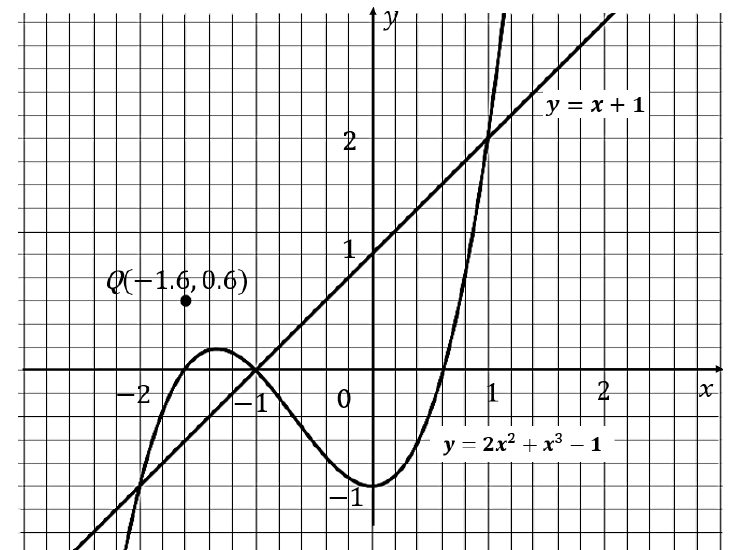
(a) Explain why the equation 2x² + x³ − 1 = k have 3 solutions for some values of k. [1]
(b) Using the 2 graphs on the grid, find the values of a, b, c and d of the inequality ax³ + bx² + cx + d ≥ 0 whose solutions are −2 ≤ x ≤ −1 or x ≥ 1. [2]
(c) Point Q has coordinates (−1.6, 0.6). A tangent to the curve can be drawn so that it passes through point Q. Find the equation of this tangent in the form y = mx + c, where m > 0. [2]
Translate the algebra into graph relationships first: horizontal-line intersections, which graph is higher, and a tangent through two known points.
View worked solution
Worked reasoning
- Read the cubic from the graph: f(x)=2x2+x3-1.
- The equation f(x)=k has three solutions when the horizontal line y=k meets the curve three times.
- The graph gives -1<k<0.2.
- Compare the cubic with the line g(x)=x+1: f(x)-g(x)=(x3+2x2-1)-(x+1).
- Simplify and factorise: x3+2x2-x-2=(x+2)(x+1)(x-1).
- The graph shows the cubic on or above the line for -2≤ x≤-1 or xge1.
- Therefore the inequality coefficients are (a,b,c,d)=(1,2,-1,-2).
- For the positive-gradient tangent through T=(-2,-1) and Q=(-1.6,0.6), m=0.6-(-1)-1.6-(-2)=4.
- Substitute Q into y=mx+c: 0.6=4(-1.6)+c, so c=7 and y=4x+7.
Final answer: (a) -1<k<0.2; (b) (1,2,-1,-2); (c) y=4x+7.
Where students get stuck
- Three solutions means three intersections with y=k.
- For the inequality, compare which graph is higher and read the intersection x-values.
- For the tangent, use two points on that line to calculate its gradient, then find its intercept.
- Translate the graph relationship before doing algebra.
What to practise next: Practise reading intersections and intervals from a graph before writing an equation.
Keep practising with
- Upper Sec Mixed Check #01A varied check where the question heading does not tell you which method to use.
- Prelim Repair #01Worked through the paper breakdown? Try six questions designed to strengthen the skills covered.
- Final Push Mini CheckSeven original mixed questions for a short final review, with complete worked solutions.